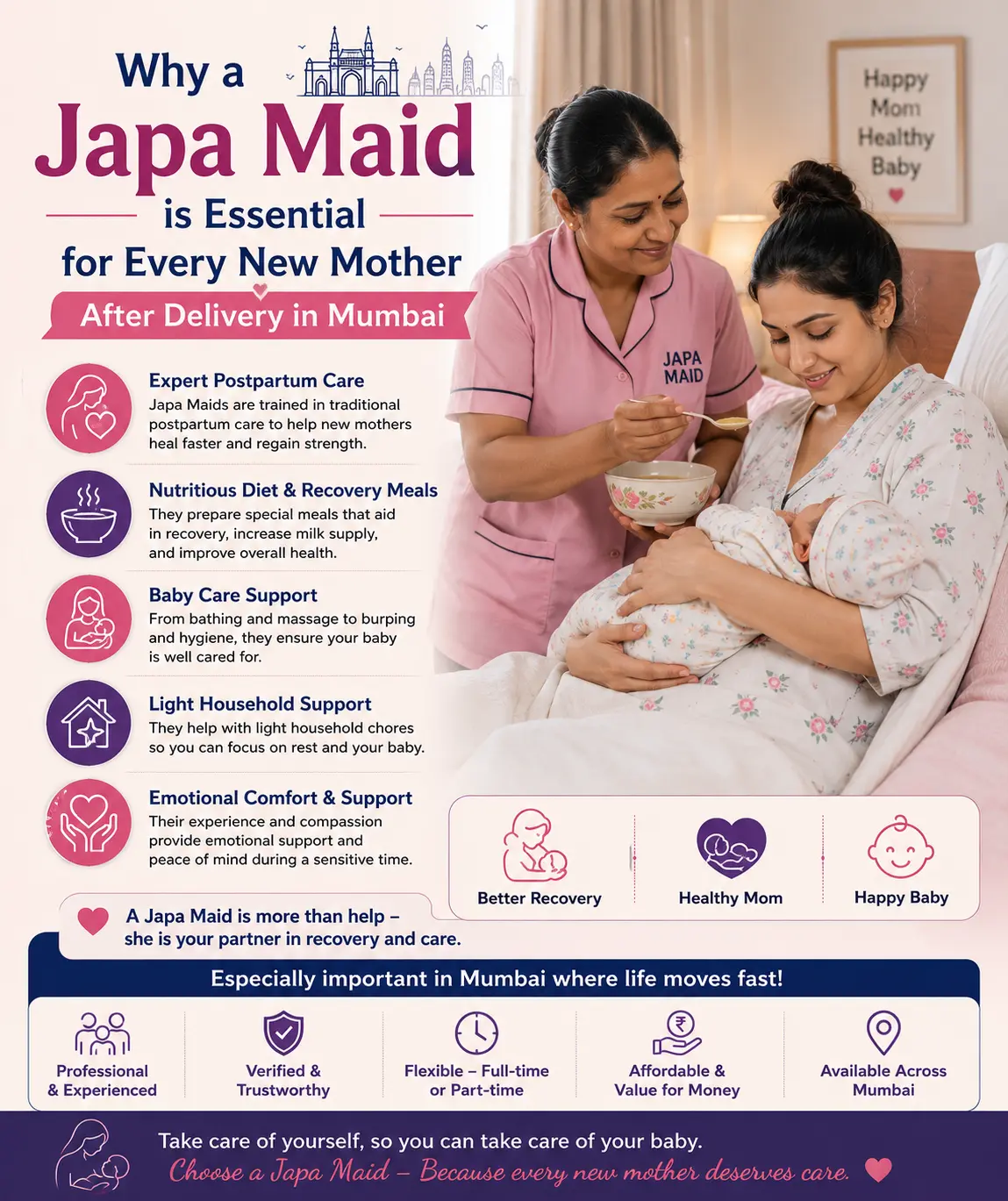
"A Japa Maid supports the mother’s recovery and newborn’s daily care during the critical postpartum weeks."
In traditional Indian culture, the weeks following childbirth were never meant to be managed alone. The postpartum period — known as the japa or confinement period — was understood as a time when the new mother needed to be surrounded by experienced women who would take over all household and newborn responsibilities so that she could rest, heal, and recover fully. Grandmothers, aunts, and neighbors would rotate through the home, cooking specific healing foods, performing the baby’s daily massage and bath, managing the household, and keeping the mother supported in ways that went far beyond practical help.
In contemporary Mumbai, this support network has fragmented. Extended families are scattered across cities, parents and in-laws are themselves aging or working, and the nuclear household often faces the postpartum period with limited help. Yet the biological reality of postpartum recovery has not changed. The mother’s body has just accomplished something extraordinary — nine months of pregnancy followed by labor and delivery — and it needs a full, deliberate period of rest and recovery to heal properly. The postnatal period is not a time to bounce back; it is a time to recover, and recovery requires support.
This is precisely what a Japa Maid provides. A Japa Maid — also called a postnatal maid or confinement helper — is a woman with specific experience in postpartum mother and newborn care. She arrives in the first days after delivery and manages an extensive range of daily responsibilities so that the new mother can focus entirely on rest, feeding her baby, and recovery. This includes traditional postpartum cooking, the daily bath and massage of the newborn, support with breastfeeding positioning and routine, night care for the baby when the mother needs extended rest, and management of the household’s basic functioning.
Traditional postpartum cooking is one of the Japa Maid’s most important responsibilities and one that is often underestimated. The postpartum diet in Indian tradition is specifically designed to promote healing, support lactation, restore strength, and warm the body after delivery. Dishes like ajwain rotis, methi laddoos, dry fruit halwa, panjiri, and dal with ghee are not just culturally meaningful — they are nutritionally purposeful. They are high in iron and calcium to replenish what delivery depletes, rich in warming spices that aid digestive recovery, and formulated to support the production of breast milk. A Japa Maid who knows this culinary tradition is preparing medicine as much as food.
The newborn’s care in the early weeks is simultaneously constant and nuanced. The baby needs feeding every two to three hours around the clock, has specific hygiene and cord care requirements, needs daily oil massage for healthy skin and muscle tone, and requires the careful, confident handling that new parents — however loving — have not yet fully developed. A Japa Maid with years of newborn care experience handles all of this with calm competence, ensuring the baby’s physical care is correct and consistent while also modeling the confidence that new parents are still building.
Breastfeeding, while natural, is not always easy. Many new mothers struggle with latch, positioning, supply, or the overwhelming combination of exhaustion and uncertainty that makes nursing feel impossible in the early days. A Japa Maid with breastfeeding experience can provide practical, real-time support — helping the mother find a comfortable position, assisting the baby with latch, and offering the reassurance that comes from someone who has seen many mothers through this exact challenge. This support in the early days, when breastfeeding success or failure is often decided, can make all the difference.
Sleep deprivation in the postpartum period is one of the most physically and mentally damaging experiences a person can endure. Sleep deprivation impairs immune function, delays wound healing, exacerbates the hormonal volatility of the postpartum period, and dramatically increases the risk of postpartum depression. A Japa Maid who takes responsibility for night feeds — or at least for settling the baby between feeds — allows the mother to sleep in extended stretches rather than fragmented twenty-minute intervals. This seemingly simple contribution has profound consequences for the mother’s recovery, mental health, and ability to bond with and enjoy her baby.
The link between adequate rest, traditional recovery practices, and reduced risk of postpartum depression is well-documented. New mothers who are supported through the postpartum period — who are not required to manage their households, whose physical needs are attended to, who have experienced guidance available, and who get enough sleep — are significantly less likely to develop postpartum depression. The presence of a warm, capable Japa Maid in the home does not just meet physical needs; it creates the conditions in which postpartum mental health can be protected.
The benefits of a Japa Maid extend beyond the mother. New fathers, navigating their own transition while managing work and trying to support their partner, benefit enormously from having a capable, knowledgeable person in the home. Households with older children benefit from having someone who can manage the baby’s routine so that the older child does not feel displaced or neglected. Even extended family feels more confident and reassured when they know a skilled, experienced postpartum caregiver is in place.
When selecting a Japa Maid, experience is the primary criterion. Ask specifically about how many postpartum placements the candidate has done, the age ranges of babies they have cared for, and any specific challenges — premature birth, twins, C-section recovery, breastfeeding difficulties — they have experience with. Personality matters too: the Japa Maid will be in your home twenty-four hours a day, often for four to six weeks. She needs to be someone you feel genuinely comfortable with — calm, discreet, warm, and respectful of your home’s preferences and culture.
Mumbai Maid Agency’s Japa Maids are experienced, background-verified, and matched carefully to your expected delivery window. We recommend beginning the placement process at least four to six weeks before your due date so that everything is confirmed and ready well in advance. We understand that timing matters enormously — you do not want to be searching for a Japa Maid the week you come home from the hospital. Our team coordinates placement proactively so that the right person is in place before you need her.
The postpartum period is not the time to prove you can manage everything on your own. It is the time to receive care, to heal, and to begin the most extraordinary chapter of your life with your new baby from a place of rest and strength rather than depletion. A Japa Maid is not a luxury — she is the oldest and most effective form of postpartum support that Indian tradition has to offer, now delivered through a vetted, professional placement process. Contact Mumbai Maid Agency today and let us ensure your postpartum recovery is everything it should be.
Need Verified Domestic Help?
Background-checked maids, cooks, nannies, japa maids & caregivers — placed within 24–48 hours anywhere in Mumbai.
Explore Our Services